


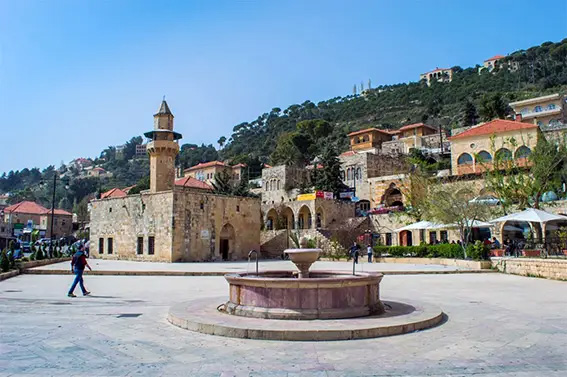
Located in the Chouf district, in the heart of Mount Lebanon, Deir el-Qamar—literally meaning “the Monastery of the Moon”—is one of Lebanon’s most emblematic villages. Perched at about 800 meters above sea level, it overlooks the valley and offers a breathtaking view of the surrounding mountains. This picturesque village is far more than a tourist attraction: it is a living witness to the country’s history. Its well-preserved traditional architecture, religious monuments, old palaces, and cobblestone streets all reflect its central role in Lebanon’s political and social history.
The capital of a principality
Deir el-Qamar’s origins date back to the Middle Ages, but it truly entered history in the 16th century when it became the administrative capital of Mount Lebanon under the Maan Emirate, an influential Druze dynasty. Emir Fakhr-al-Din II, a central figure in modern Lebanese history, made it his main residence. A man of openness, he maintained diplomatic relations with European powers, particularly Florence and Venice, and undertook a series of reforms to modernize his territory. Exiled to Tuscany in 1618, he returned five years later accompanied by architects. In Deir el-Qamar, he built public buildings, gardens, and palaces, and introduced architectural elements inspired by the Italian Renaissance. Under his rule, the village became a true center of cultural, administrative, and economic influence. This period marks the birth of Lebanese architecture—a blend of Eastern and Italian forms.
In the 18th century, the Chehab dynasty succeeded the Maans. Beiteddine, a few kilometers from Deir el-Qamar, gradually became the new center of power, but Deir el-Qamar remained a strategic village. It was also a place of interreligious coexistence. Christians, Druze, and Muslims lived there in relative harmony. A notable symbol of this coexistence was the construction in 1638 of the Fakhreddine Mosque, the first mosque in Ottoman Mount Lebanon, located just a few steps from the Church of Our Lady of the Hill (Saydet el-Tallé). This proximity reflects the religious tolerance that characterized the local society during certain periods of its history.
A declining capital
However, this coexistence was violently disrupted in the 19th century. In 1840, 1845, and 1860, bloody clashes erupted between Christian and Druze communities in Mount Lebanon. Deir el-Qamar, then predominantly Christian, was attacked and suffered heavy human and material losses. These massacres had lasting consequences on the region and accelerated the village’s administrative decline, in favor of Beiteddine. Despite these tragic events, Deir el-Qamar retained its symbolic importance. During the Mutasarrifya (1864–1918), the autonomous province of Mount-Lebanon, Deir el-Qamar remained influential, with its notables often courted by the Ottoman governor. But from 1920 onward, the former capital of the Lebanese Emirate was supplanted by Beirut, the capital of Greater Lebanon. The old trade route linking Syria to Saida through Deir el-Qamar was replaced by the Beirut–Damascus highway.
In modern times, the village has remained a notable cultural center. It was the birthplace of several political figures, including Camille Chamoun, President of Lebanon from 1952 to 1958. Deir el-Qamar’s architectural heritage has been carefully preserved: the emirs’ palaces, old mansions, churches, and mosques still bear witness to the village’s historical richness. The Marie Baz Wax Museum, housed in one of these palaces, features a collection of wax statues representing prominent figures in Lebanese history.
Today, Deir el-Qamar is a nationally recognized heritage site. It draws numerous Lebanese and foreign visitors eager to discover its prestigious past and enjoy its peaceful ambiance. The village embodies both the memory of a diverse Lebanon and the desire to preserve a shared heritage. It remains a place for strolls, historical reflection, and dialogue among cultures and faiths.
Comments are closed